
Ever stood in front of a yawning class with a lesson on the Treaty of Versailles and wished you had something better than a pop quiz? Or maybe you just want a line for the group chat that won’t fall flat. You’re in the right place.
History jokes are short jokes, puns, and one-liners built on real people, events, and eras. This list has 150+ of them, from short history jokes to history wordplay that sneaks in an actual fact. Everything here is clean, so you can read it to a classroom or text it to your grandma.
Scroll by topic or jump straight to your favorite era. If a joke makes you groan, it worked. Tell us which one got you in the comments, and share your top picks with the history nerd in your life.
Best History One-Liners and Puns
These are the best history jokes to open with because they’re quick. You get a name, a twist, and a punchline in one breath. That makes history one-liners perfect for a text, a whiteboard, or a laugh before the bell.
Puns do the heavy lifting here. A good pun twists a famous name or event just enough to make people groan and grin at once. Think of it as the warm-up lap before the longer stuff.
Read them out loud before you share them. If one makes you smile, it’ll probably land with your crowd too.
- I’d tell you a joke about the Roman Empire, but it fell apart before the punchline.
- Cleopatra was the queen of denial.
- Alexander the Great never shared a map. He wanted the whole world to himself.
- The Great Wall of China is the longest “keep out” sign ever built.
- Vikings didn’t do trust falls. They did trust raids.
- Henry VIII had six wives and zero patience for “we need to talk.”
- Abraham Lincoln kept his speeches short and his hat tall.
- Christopher Columbus was the original lost driver who refused to ask for directions, and still got a holiday.
- Napoleon Bonaparte wasn’t actually short. He was about average for a Frenchman of his day, and history loves a good roast.
- The Trojan Horse was history’s first gift that kept on taking.
- Marie Antoinette probably never said “let them eat cake,” but the cake still follows her around.
- Julius Caesar had a great week until the Ides of March.
- Leonardo da Vinci left half his projects unfinished, so he’d fit right in with any group project.
- The Industrial Revolution was great for factories and terrible for the dream of working from home.
- The Renaissance gave us Michelangelo, da Vinci, and the invention of “I’ll finish it tomorrow.”
Funny History Q&A Jokes and Riddles
Q&A jokes give people a chance to guess, which is half the fun. The question sets a trap and the answer springs it. Many of these double as educational jokes, since you need to know the name to get the pun.
History riddles take it one step further. They turn a famous person or place into a guessing game, so they work great for road trips and classroom warm-ups.
Why was the Middle Ages called the Dark Ages?
Because there were too many knights.
Why couldn’t Cleopatra admit she was wrong?
She was in de-Nile.
Why did the mummy take a vacation?
He needed to unwind.
Why did Alexander the Great make such a good math student?
He kept dividing and conquering.
Why would Columbus make a terrible tour guide?
He kept ending up in the wrong place.
How did the Vikings send secret messages?
By Norse code.
Why did the king go to the dentist?
To get his crown checked.
Why were the Romans never lost?
All roads led to Rome.
What kind of music did the Pilgrims listen to?
Plymouth Rock.
How upset were the colonists about the tea tax?
Tea-tally upset.
What has seven hills, a famous Colosseum, and statues with missing noses? (Riddle)
Rome.
I was a gift that arrived with soldiers inside. What am I? (Riddle)
The Trojan Horse.
I sailed in 1492 and thought I’d reached India. Who am I? (Riddle)
Christopher Columbus.
I’m the world’s longest wall, and tourists love to climb me. What am I? (Riddle)
The Great Wall of China.
Classic History Jokes Everyone Knows
Classic jokes are the ones your teacher told, and their teacher told before that. They’ve survived because the structure is airtight and the groan is guaranteed. These historical jokes keep showing up in classrooms and group chats for a reason.
Here’s a quick test. If you can hear someone’s dad saying it, it’s a classic. Try one at dinner and watch the eye rolls roll in.
- Why did the pharaoh start a pyramid scheme? He wanted to build something that lasts.
- Why did George Washington stand up in the boat while crossing the Delaware? The painter wanted a better composition.
- What’s the difference between a pirate and a historian? One looks for buried treasure, the other for buried facts.
- Why did the Renaissance painter get promoted? He really knew how to frame a situation.
- Why don’t Romans take selfies? They prefer busts.
- Why was the Gutenberg press so popular? Everyone was impressed.
- Why did the samurai bring a ladder to the dojo? He heard the training was on another level.
- What did the Cold War say to the Iron Curtain? “Let’s keep things chilly.”
American History Jokes
American history jokes cover a lot of ground, from the American Revolution to the Wild West. They land best when the punchline sits next to a real fact. That’s why you’ll spot a few true details tucked in below.
Ask yourself what kids actually remember about the Boston Tea Party. It’s usually the tea in the harbor, not the tax. A joke gives that image a second life, and these presidents jokes do the same for the White House crowd.
- The Declaration of Independence was basically a breakup letter to King George, with 56 signatures.
- George Washington never had wooden teeth. His dentures used ivory, metal, and even human teeth, which makes the wooden version the nicest rumor.
- The Boston Tea Party dumped 342 chests of tea into the harbor. Imagine the cleanup.
- Abraham Lincoln was reportedly a champion wrestler who lost almost no matches. Not bad for a guy known for his hat.
- The Wild West had a stricter dress code than most offices. Many towns made cowboys check their guns at the edge of town.
- The Industrial Revolution invented the “just one more hour” shift, and we still haven’t gotten rid of it.
- The Liberty Bell cracked early in its career, long before anyone said “cracked under pressure.”
- Congress cut about a quarter of Thomas Jefferson’s draft, which makes it the most famous edit in history.
- Teddy Roosevelt refused to shoot a bear on a hunting trip, and the teddy bear was born.
- Benjamin Franklin invented bifocals, the lightning rod, and a better stove, and patented none of them. Bad for profit, great for everybody else.
- Nobody can prove the Pilgrims actually stepped on Plymouth Rock. The rock has been taking credit for 400 years.
- Gold Rush merchants often made more money selling shovels and jeans than miners made digging for gold.
Ancient History Jokes (Egypt, Rome, Greece and More)
Ancient history jokes are a gold mine because the cast is so dramatic. You’ve got pharaohs, gladiators, philosophers, and gods who hold grudges for centuries. Ancient civilization jokes don’t need much help.
Here’s the fun part. A lot of the “weird” details are real, like the fact that Egyptian pyramid builders were paid workers who got beer rations. A joke with a true fact inside sticks to your brain.
Take your time with this section. Each civilization gets a few lines, so pick the one your audience cares about.
- Egyptian pharaoh jokes usually skip the plot twist that the pyramid builders got paid, and that their rations included beer.
- Ancient Egypt had the first long-term storage plan, and it was called a pyramid.
- The Great Pyramid of Giza was the tallest man-made structure for about 3,800 years. That’s some serious job security.
- Ancient Rome had heated floors, public baths, and concrete that still stands. Meanwhile, my phone dies at 3 percent.
- The Colosseum held roughly 50,000 spectators. Ancient Rome handled crowds better than most concerts.
- Roman Empire jokes always end with the same truth: Rome wasn’t built in a day, but it fell in a few centuries.
- Roman numerals were history’s first lesson in why math shouldn’t look like a word search.
- Greek mythology jokes write themselves. The gods fight, flirt, and hold grudges, like a family group chat with lightning.
- Alexander the Great conquered most of the known world before he turned 33. Meanwhile, I can’t parallel park.
- Ancient Greece invented democracy, the Olympics, and philosophers who argued about what a chair really is.
- The Trojan Horse taught history one lesson. Always inspect the gift before wheeling it inside the city.
- Socrates never wrote a book. His students did the homework.
- The Sumerians invented writing around 3,400 BCE, mostly to track grain. History’s first big project was a spreadsheet.
- The Maya built pyramids in the jungle without metal tools. Meanwhile, I need a video to hang a shelf.
- Ancient Mesopotamia gave us the first known recipes, written on clay tablets. That’s the original food blog.
World History Jokes (Medieval, World War II and Beyond)
World history jokes take you from castles to codebreakers. Medieval jokes have plenty of fun material, like armor, moats, and the age of the sword. Later eras need a lighter touch, so these stay on the clean, gentle side.
Picture a classroom studying World War I and II. A joke about codebreakers or the “war to end all wars” title breaks the tension without making fun of anyone. That’s the sweet spot for World War II jokes.
The rest of this list jumps around the globe. Pick one era or skim all of them.
- Middle Ages knights wore roughly 50 pounds of armor. Great workout, zero pockets.
- After the Black Death, workers were scarce, so peasants asked for raises. History’s first successful “we’re short-staffed” negotiation.
- Viking jokes have a hidden truth. Vikings never wore horned helmets, and the myth took off after an 1876 opera costume.
- Genghis Khan built the largest connected land empire in history with no maps app.
- A samurai carried two swords, which is more backup than most of us have for a phone charger.
- World War I was called “the war to end all wars.” That was history’s most optimistic title.
- World War II jokes with a happy ending: Alan Turing’s team at Bletchley Park cracked Enigma, proving that group projects can work.
- Rosie the Riveter taught the world that “We Can Do It” includes the whole shift.
- The Cold War was a 40 year staring contest, and the space race was the halftime show.
- The spinning jenny sounds like a dance move, but it helped launch the Industrial Revolution.
- The Silk Road was the first online store. Shipping took a few years, and the delivery driver was a camel.
- The Berlin Wall came down in 1989, proving even the biggest projects can be undone with enough people and a few hammers.
- Medieval jokes about castles always forget the moat’s real job. It was the world’s first “no soliciting” sign.
- Printing presses spread ideas faster than any messenger, which means the first viral post had a lot of ink.
- The Ottoman Empire lasted over 600 years. That’s longer than most streaming subscriptions will last.
If you enjoy culture-themed humor, you can also check out these Mexican jokes.
History Dad Jokes and Knock-Knock Jokes
History dad jokes run on pure groan power. They’re puns with a straight face, and they work best when delivered with extra confidence. If somebody sighs and smiles at the same time, you nailed it.
History knock-knock jokes are great for kids and anyone who likes a little ritual. You say the line, they say the line, and the pun does the rest. Try these at the dinner table.
- What’s a historian’s favorite fruit? A date.
- I tried to explain the Black Death to my kids. They said it was a sick joke.
- I wanted to tell a joke about the Great Wall of China, but it went on too long.
- Napoleon gets credit for a palindrome he probably never said, “Able was I ere I saw Elba.” It’s perfect dad material because nobody can prove it.
- Why was Abraham Lincoln so good with short messages? His Gettysburg Address ran about 270 words.
- Why are historians good at relationships? They love dates.
- I’m reading a book on the history of glue. I can’t put it down.
- Why did the Roman go to the gym? To work on his Caesar abs.
Knock knock.
Who’s there.
Caesar.
Caesar who.
Caesar jolly good fellow.
Knock knock.
Who’s there.
Cleopatra.
Cleopatra who.
I’m in de-Nile about how long you’ve kept me out here.
Knock knock.
Who’s there.
Viking.
Viking who.
Viking me crazy, open the door.
Knock knock.
Who’s there.
Knight.
Knight who.
Knight-mare if you don’t let me in.
Knock knock.
Who’s there.
Pharaoh.
Pharaoh who.
Pharaoh-ver I wait, you never open the door.
History Jokes for Kids and Classrooms
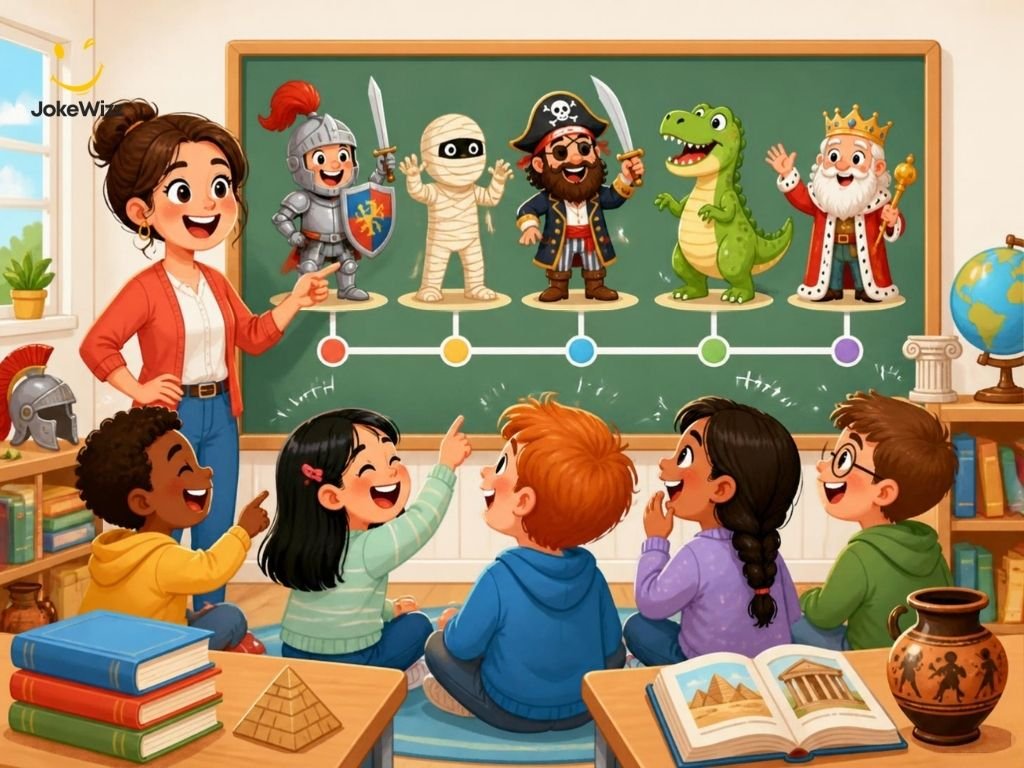
Kids love history jokes because the punchlines are silly and the stories are huge. Pirates, knights, mummies, and dinosaurs are already cool. A joke just gives them a reason to remember the names.
That’s the heart of classroom humor. A short, clean history joke at the start of class wakes everybody up. It’s also an easy way to ease into a lesson without a big speech.
Try one as a warm-up, an exit ticket, or a Friday reward. If the kids try to write their own, even better.
- Why did the knight bring a pencil to battle? To draw his sword.
- Why do pirate jokes make terrible homework? Pirates give out arrrr-signments.
- What did the mummy do on the first day of school? He wrapped up his notes.
- Why was the dinosaur left out of the history book? It happened before recorded time.
- Why was the castle so good at math? It had a lot of moat-ivation.
- What did the Egyptian student say about his missing homework? “I’m not lying, I’m just in de-Nile.”
- How did the Vikings pass their tests? They sailed through.
- Why is history the easiest class? Everything you study already happened.
- Why did the king bring a ruler? To measure his kingdom.
- Why did the Pilgrim cross the Atlantic? The bus wasn’t running.
- What’s a pirate’s favorite subject? Arrrr-t.
- Why did the explorer bring a map to bed? He wanted to sleep on the road.
Kids who love silly humor may also enjoy these Minion jokes.
History Jokes for Teachers and History Majors
Teachers and history majors share a special kind of humor. They know too many dates, they’ve read too many footnotes, and they’ve survived a debate about which source counts as primary. These history teacher jokes and history major jokes speak their language.
If you teach, drop one on the last slide before a long unit. You’ll get a groan, a laugh, and probably a photo someone sends to their parents. Many of these also work as history jokes for adults, since you need a few years of school to get them.
- History teachers love the past tense. It’s the only tense that never changes.
- History is the only show where all the spoilers are in the textbook.
- A history teacher’s end-of-year song is always “We Didn’t Start the Fire.” Nobody asked them to.
- When students ask “Will this be on the test?” the answer is “Everything that already happened is on the test.”
- “Tell me about yourself,” says the interviewer. “Which century?” says the history major.
- A history major can predict anything, as long as it already happened.
- Ask a history major about their career plan, and you’ll hear “It’s a work in progress, like the Hundred Years’ War.” That war actually lasted 116 years.
- History majors don’t procrastinate. They practice strategic delay, like the Roman general Fabius.
- A historian’s love language is a footnote.
- The only thing history majors love more than primary sources is a long argument about what counts as one.
- History teachers never get lost. They call it exploring an alternate timeline.
- Why did the history major bring a pillow to the archives? For the long-term research.
Famous Figures and Historical Events Jokes (Presidents, Kings and Explorers)
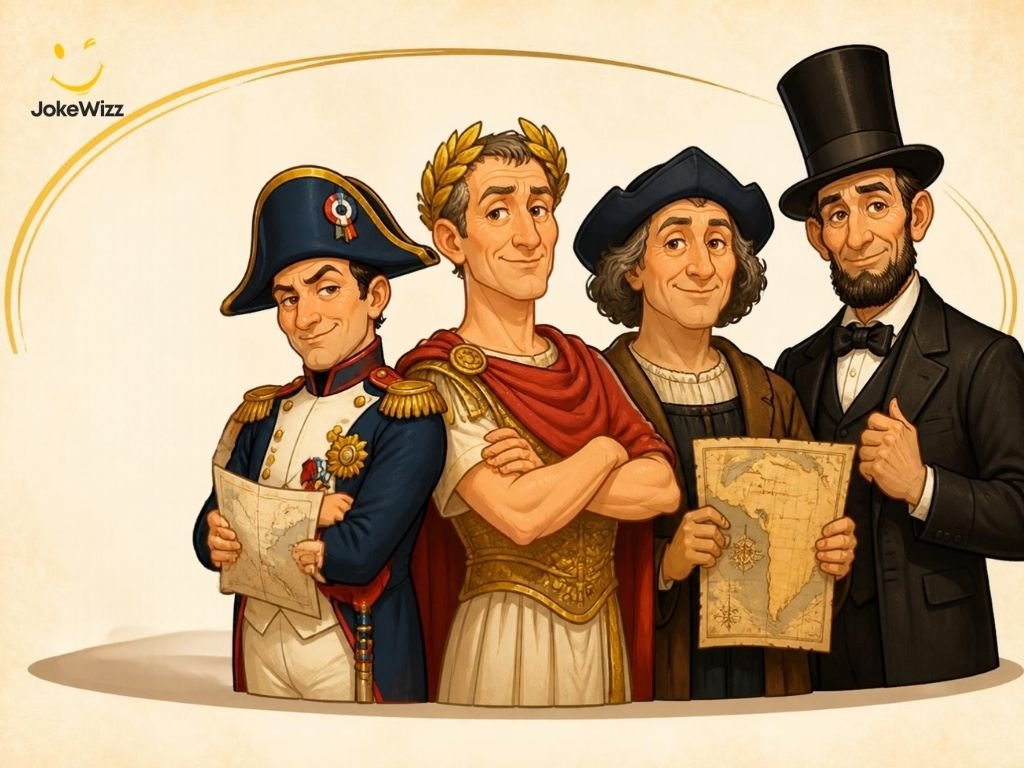
Famous figures make the best targets because everyone knows at least one fact about them. Your audience already has the setup in their head, so the punchline hits fast. This is where king and queen jokes, presidents jokes, and explorer jokes shine.
You’ll spot Cleopatra, Napoleon, and a few friends below. They’re all real people with surprisingly human quirks. That’s what makes the jokes work.
Grab the group that fits your crowd and go.
Presidents
- George Washington turned down a third term, which makes him the only boss who quit while ahead.
- Abraham Lincoln is the only U.S. president with a patent. His invention was a device for lifting boats over shallow water.
- Thomas Jefferson and John Adams both died on July 4, 1826, exactly 50 years after the Declaration. That’s perfect RSVP timing.
- Teddy Roosevelt turned a hunting trip into a stuffed animal empire.
- Benjamin Franklin never became president, but he’d have won a popularity contest anyway.
Kings and queens
- Queen Victoria reigned for 63 years. Her heir waited so long he practically had a part-time job.
- Louis XIV wore red high heels and a giant wig. He was the original “dress for the job you want.”
- Cleopatra was Greek by descent and still became the most famous Egyptian queen. That’s the ultimate “live where you rule” story.
- Marie Antoinette gets blamed for a quote she likely never said. Talk about a bad PR team.
- Napoleon Bonaparte conquered much of Europe, then lost it all in one afternoon at Waterloo.
Explorers
- Christopher Columbus died believing he’d reached Asia. That’s the ultimate “I’m sure the GPS is right.”
- Ferdinand Magellan never finished his own trip around the world. His crew did.
- Leif Erikson reached North America around 1000 CE, about 500 years before Columbus, and still gets less airtime in textbooks.
- Lewis and Clark crossed a continent with a dog named Seaman and zero Wi-Fi.
- Marco Polo came home from Asia with stories so wild that some people wondered if he made them up.
For another quick laugh, check out these bald jokes.
History Puns for Instagram and Social Media Captions
A good caption is short, a little cheeky, and easy to steal. These history captions and history puns for Instagram are ready to copy for travel photos, museum selfies, or that one picture of you with a column.
Don’t forget history memes either. A famous painting, a quick pun, and a clean joke on top can travel fast. Add hashtags like #HistoryJokes, #HistoryPuns, and #HistoryNerd for extra reach.
- Making history, one caption at a time.
- Not to be dramatic, but the Roman Empire wasn’t built in a day, and neither was this outfit.
- Born to study the past, forced to live in the present.
- Plot twist: I’m just here for the Colosseum views.
- I came, I saw, I took 47 photos. Julius Caesar would be proud.
- Dear past, thanks for the memories. The plague was optional.
- History repeats itself, so I’m just here for the good parts.
- I’m not old, I’m vintage. Ask Ancient Rome.
- The “Keep Calm and Carry On” poster was printed in 1939 and barely used. It found fame 60 years later on mugs.
- Just a person and their Great Wall of China photo.
- Pirate life: where every map has a mystery and every selfie is treasure.
- Living in the history books, one page at a time.
- Currently exploring the Middle Ages, minus the armor.
- Stuck in the past, but the Wi-Fi is better here.
Looking for more caption ideas? Try these funny Wednesday jokes.
Funny History Facts That Sound Like Jokes but Are True
Some funny history facts are so odd they feel made up. The good news is that they’re real, and they make great trivia and even better icebreakers. Dropping one in class or at dinner makes you look like the smartest person in the room.
Each fact below comes with a quick laugh. That’s the whole point. If it makes someone say “wait, really?” you’ve done your job.
- Oxford University is older than the Aztec Empire. Teaching there started around 1096, while Tenochtitlan was founded in 1325.
- Cleopatra lived closer in time to the moon landing than to the building of the Great Pyramid.
- Harvard is older than calculus. It opened in 1636, and calculus showed up decades later.
- The shortest war in history, the Anglo-Zanzibar War of 1896, lasted somewhere between 38 and 45 minutes.
- Woolly mammoths were still alive when the Great Pyramid of Giza was built.
- The Caesar salad has nothing to do with Julius Caesar. A chef named Caesar Cardini created it in Tijuana in the 1920s.
- The Eiffel Tower was meant to be temporary, with a permit of about 20 years. It stuck around.
How to Tell a History Joke So It Lands
The best jokes fall flat if the delivery is off. A great history joke needs a quick setup, a clear twist, and a pause before the punchline. Most of that comes from practice, not talent.
Think about the room too. A joke about Henry VIII is fine at a family dinner, but you’d want a lighter touch around anything that involves war or loss. A little care keeps your humor fun for everyone.
- Know the fact first. If you don’t understand the event, the joke will wobble.
- Keep it short. One setup line and one punchline is plenty.
- Pause before the twist. Give people a second to see it coming, then deliver.
- Pick your audience. Kids love pirates and mummies, while adults often prefer Cleopatra and Napoleon.
- Skip the explaining. If you have to explain it, tell a different one.
- Smile when you finish. A grin tells people it’s okay to laugh.
History Jokes for Quiz Night and Trivia Teams
Quiz night and humor go together like Vikings and boats. History trivia jokes loosen up the room, give teams a laugh between rounds, and make the host seem a lot cooler. Plus, they’re a smart way to tell which team knows its dates.
Try a few as tiebreakers or as a “joke round” after the serious questions. Winners get bragging rights, losers get a groan, and everyone goes home happy.
Which Roman emperor is best at hide and seek?
Nero, because everyone was busy watching the fiddle.
Which famous queen always won the staring contest?
Cleopatra, because nobody could keep a straight face in front of her.
What do you call a pirate who knows his history?
A treasure of knowledge.
What was the first rule of Viking trivia night?
Never raid the snack table.
Which president would have won every trivia night?
Lincoln, because he always had the right answer, and a great hat.
Need a team name? Try “Et Tu, Quiz?”, “Pyramid Schemers,” “The Hundred Years’ Quiz,” or “Quiz Antoinette.”
Why History Jokes Work (and Why Students Remember Them)
A joke grabs your attention in a way a timeline can’t. It takes a name or a date and wraps it in a surprise, so your brain pays attention. That’s why a pun about the Trojan Horse sticks better than a paragraph about the Trojan War.
Studies on classroom humor suggest it can improve attention and sometimes memory, though the results vary by age and subject. The takeaway is simple. Humor helps most when it’s tied to the actual lesson.
So don’t use jokes as a gimmick. Use them as a hook, then circle back to the facts. If students laugh first and learn second, you’ve won.
Keep the Past Laughing
History jokes make the past feel closer, and they turn names, dates, and wars into stories people actually share. You now have 150+ of them, from punchy one-liners to riddles, captions, and trivia. Pick a few favorites and try them out loud.
Now it’s your turn. Drop your best history joke in the comments, share this post with a teacher or a history buff, and come back soon, because we update this list as new jokes roll in.
FAQ
What are some good history jokes?
Good history jokes pair a real person or event with a clean twist. Try “Cleopatra was the queen of denial” or the Trojan Horse line. The best ones also teach you something.
What are funny history puns?
Funny history puns twist a famous name or event into wordplay, like “Viking me crazy” or “Norse code.” They work well in captions and classrooms. Read them out loud to see if they land.
What is a good history joke for kids?
Try “Why did the knight bring a pencil to battle? To draw his sword.” Kids love pirates, knights, and mummies. Keep it short and silly.
Are there clean history jokes for school?
Yes, every joke on this page is clean. Stick with puns, riddles, and one-liners about kings, explorers, and ancient civilizations. They’re safe for any classroom.
What’s a good history joke for teachers?
Try “Everything that already happened is on the test.” It’s quick, relatable, and students will groan on cue. It also works as a lesson opener.
Why do teachers use history jokes?
Teachers use them to grab attention and make a lesson easier to remember. A joke can ease tension before a tough unit. It also shows students that history is about real people.
What are some funny jokes about ancient Rome?
Try “Why don’t Romans take selfies? They prefer busts” or “All roads led to Rome, but nobody mentioned the toll.” The Colosseum and Julius Caesar make great targets.
What are some American history jokes?
Start with the Declaration of Independence “breakup letter” or the Boston Tea Party cleanup. Pair a joke with a true fact for the biggest laugh.
What are good history captions for Instagram?
Short, cheeky lines work best, like “Making history, one caption at a time” or “I came, I saw, I took 47 photos.” Add a hashtag like #HistoryPuns for reach.
Do history jokes help students remember facts?
They can. Humor boosts attention, and a memorable punchline gives the fact something to hang on. Results vary, so pair the joke with the lesson.

Tahir Abbas is the writer behind JokeWizz, where he shares puns, one-liners, and jokes across dozens of everyday topics. He believes a good laugh shouldn’t need a search bar, so he writes the kind of humor you’d actually text a friend.